Saturday, 27 December 2025

What's New


20:00 - 25th August 2022 - Added Cars Part 1
17:26 - 28th September 2020 - Added Woellwarth & Co.Personalities
17:26 - 28th September 2020 - Added Woellwarth & Co.My Personal Background
15:35 - 28th September 2020 - Added Woellwarth & Co. Part 2
17:36 - 30th October 2017 - Added Woellwarth & Co. Part 1
17:30 - 30th October 2017 - Added Our First House- in Billericay
15.30 - 6th October 2016 - Added We have a Baby!
15.30 - 6th October 2016 - Added American Express and a Life Change
12:30 - 5th October 2015 - Added Julius Baer Wasn't To Be My Long Term Home
13.30 - 25th September 2015 - Added Finding out about a new world.
13.30 - 25th September 2015 - New Job and New Home
10.27 - 4th August 2015 - Added Julius Baer International the first couple of weeks.
11:09 - 4th June 2015 - Added Final Wrap up on the District Bank
15.52 - 25th March 2015 - Added An Aside on the Use of Fed Funds in the London market 1960s
15.52 25th March 2015 - Added District Bank Wrap Up - Part 2 - read this before the one above
12:49 24th February 2015 - Added Wrap Up On the District Bank Part 1
14.57 29th December 2014 - Added Me and the Bank of England
19:53 8th December 2014 - Added Having the time of my life - Canada
1:43 18th November 2014 - Added Inflation Indices and Billions
10:57 2nd November 2014 - Added One of the Most Exciting Years of My Life
15:15 14th September 2014 - Added Living in Watford
20:13: 24th July 2014 - Added Honeymoon
9:28 June 6th, 2014 -Added The Bouncing Ball
12:38 May 26th, 2014 - Added Marriage Part 2
17:16 April 14th, 2014 - Added So - life to date - a summary
17.36 January 20th, 2014 - Added Marriage - and all that! Part 1
17:42 December 27th 2013 - Added Leading Up To Marriage
14:46 December 27th 2013 - Added "Humour"
21.30 October 25th - Added "But Going To Hear Live Music Was Even Better
20.30 October 18th - Added "Listening to music was a big thing!
22.00 October 14th - Added Music in the Early '60s
21:38 October 11th - Added Personal Things - Scouts

Please let me know what you think - My E-Mail david@bbbweb.com

David

Thursday, 25 August 2022

Cars - 1

 I thought that I might take a break from historic events and try and explain my trip through a variety of cars. This will be a simple list with a few comments about each. Although I am only up to the late 1970s with this blog, this list will come up to date.


  1.  Circa 1963 - 1947 Austin 10 - brought from one of our assistant scoutmasters - the one that we called "Asm". It was a nice little car  with a registration that I would like now which was DPX52. It had dodgy brakes and variable steering and cost me £10.


    I took Valerie out in it one day and we had a bit of trouble stopping it on one occasion. I tried to insure it but that was also £10, which was more than one weeks salary for me at that time and a cost that was out of my reach so I sold it and got £10 for it!
  2. Once we were in Norbury and me settled in a much better paying job, I started hiring cars for various weekends and bank holidays. The cars of choice were either a Vauxhall Viva or a Ford Capri. I have a memory of taking the cars back with a little pile of cigarette ash on the floor by my right foot! I stopped smoking not long after
  3. Once I was at Woellwarth and living in Billericay, it was obvious that we needed a car. Mistakenly, I bought a Ford Escort from Roy Jarvis, one of my Spot DM colleagues. This was a converted van and was awful. Reversing out of the garage at my house, I tore the exhaust pipe off so it had to go - for scrap. It's number plate was OO 7303 - what a great one to have nowadays.


  1. Brian next door had a friend that had a Hillman Imp going cheaply so that was next. It was a nice little thing in pale blue. The back seat could be folded down  but how we coped with both Sam, who was  around 3 then, and Simon who was 1 I cannot remember.  You can see Sam and me below.

  1. Eventually, we decided that we should get a decent car, so we went down to Allens of Romford, the local main ford dealer and bough a 2 year old dark metallic green Ford Escort GT. Not to quick by today's standards but very snappy for those days.
  2. I got very excited about the Ford Escort Mexico and fancied doing a bit of rallying if I could get one but... It only had two doors and the insurance was very expensive. Hence, I bought a brand new Ford Escort GT in a strange shade of red/pink. I took this off the road one night and bent the suspension showing Valerie's younger brother, Terry, how good it was. It had new had Pirelli tyres that didn't like a greasy road! Oh well.
  3. We were moving up in the world and my salary was expanding very quickly so the Ford went quite quickly to be replaced by a Triumph Dolomite.


    SGX663L - so close to SBX it makes my head turn :-)

    What a nice car. What a terrible gear box. By then I already had arthritis in my neck causing issues with my left arm and this gearbox was very difficult. It went into Triumph on about 5 occasions.
  4. It is now late 1973 and, in addition to our two children, we now had a fast growing Golden Retriever. Triumph Dolomite? Too small! All of a sudden, we can afford a much bigger and more expensive car.  Average annual salary in the Uk was around £1,980 per annum.  A brand new blue Volvo 245 estate? £2,499.00! I went off to Munich soon into the new year and, while I was there, I purchased a nice set of sheepskin covers for the front seats. Goodness knows why. When I came back, Mum had run the car down against Grandad's gate in Romford so there was a lovely gouge all the way down the offside of the car.
  5. It turned out that, with the big petrol crisis, keeping the Volvo was quite difficult so it got swapped for another, red, Dolomite. I had some trouble with this (I should have known better after the previous experience) so it got sold off for one of the new VW Golf range. This was a nice little car for four of us and Cindy could jump in the back.
  6. 1975 brought Wendy along and, once again, the car was too small. The local Volvo dealer had a high mileage 245 that was only a couple of years old and was sold with a warranty. This one was a nice dark green and ran perfectly. 
  7. Inflation kept roaring away and now we had two lots of school fees to pay so, under pressure from the bank manager, the Volvo was swapped for an Austin Maxi which I could get for cash and all paid up. This was one unreliable car. We are now around 1978-9.
  8. I am now working at Nordic Bank and enjoying life even though, again, we are under a little pressure. At lunch, one day, I was offered a new job that came with a company car and more money.  We now have - guess what - a dark red Volvo 245! This was a three year deal so I couldn't think about another car throughout that time. 
  9. After 3 years, the car came up for renewal. We had a new, less generous General Manager so there was a tighter restriction on the cost of company cars so I had to be a bit creative. Again, I fancied a Ford RS Escort but, again, there was the issue of two doors! Hence, I got a nice bright red 1600 Ghia with wider wheels and an RS steering wheel. It was a dream after the Volvo. We had four children by now and the car was a bit cramped but Sam was now 14 and Simon 12 so they had quite a lot of other things to do as they were both active in the Scouting movement.
  10. The bank closed down about 9 months later so, again, cars were on the move. I became Treasury Manager of the follow-on bank with a new company car, again! (Sorry about all the exclamation marks). There was a tight budget for a company car but Ford were just launching the Sierra and I was able to get a red Sierra Ghia which was larger than the Escort and more luxurious. The Escort went to one of the dealers from the old bank who transferred with me to the new one.
  11. One last car from my banking career. I joined Banque Francaise du Commerce Exterieur as chief dealer in September 1994. I felt that it was better to be a smaller fish in a big tank than a big fish in a small talk, as it were. Again, I had to change cars and along came another Volvo 245. This time a nice metallic silver GL - a very nice car that I managed to back it up against a post outside the curry place at Gidea Park Station. (This is a sample - not my one).


I think that this is enough for now. I will continue with the next edition.

Friday, 2 October 2020

Woellwarth & Co. Personalities

 So who do I remember? I will miss out loads of people as I can't remember all their names).

Going round the room from the door -

US Deposits

Reg Winterbourne (MD)
Tony Woellwarth (Chairman)
Johnny Carlin - Finacor Paris link man (sailed in HMS Fencer during the war)
Alan Bedwell - on a trip to NY, he picked up a copy of Report from Engine Company 82 for me - I still have this.
Robert Winterborne (Reg's son).

Sterling Deposits

David Robinson  - keen on cars like me - he had a Cortina 1600E - and lived in Emerson Park.
Can't remember his colleague's name.

Canadian $ FX

Originally David Raison but he moved over the the DM section under me.
Doug - can't remember his surname
Richard  - can't remember his surname

French Franc and Italian Lire

John Williams - Manager and 100% nice guy
Dave Watson
Turner Temple
Paul Waghorn (Gerry's brother)
'Grimsdale' - not his name but a nickname given by Graham Winterbourne as he shrieked like Norman Wisdom when excited!
Eileen - no surname, sorry - she took the line to Finacor Paris

D Mark FX

Originally Tony le Ray-Cook was the manager
Replaced by Roy Jarvis
Replaced by David Lincoln
Keith McCloud - took the line to Finacor Munich
Graham Winterbourne (Reg's nephew)
Bob Davis
Me (took the line to BEG Zurich)
Linton Viney
Roger Whittle (my best man and long term friend)
David Raison

US$ FX

Reg Heath (from the Savage and Heath family - competing brokers)
Ron Strudwick - Struddie
Nigel Staughton-Harris (Ex Astley & Pearce - we had some history!)
John Lake
Steve Punkett
Gerry Waghorn (Paul's brother)

Some images


John Williams

Roy Jarvis

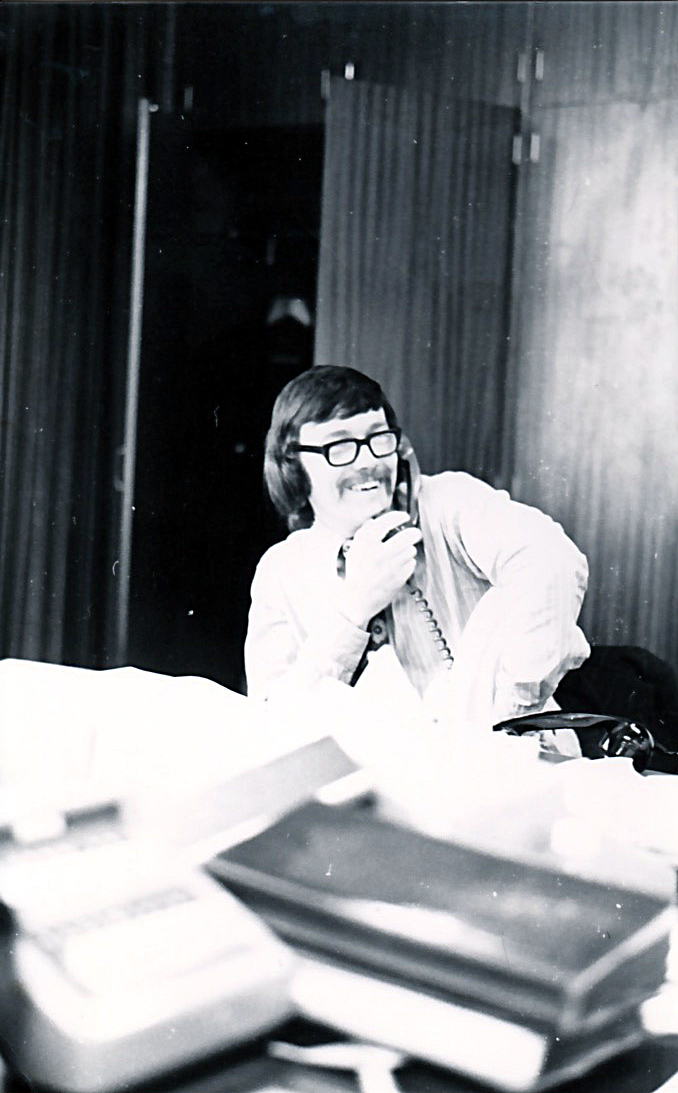
Bob Davis, Keith McCloud and me. Check out the silly changes to the calendar on the wall!


Bob Davis

Canadian $ - Richard smoking a cheroot!


A view of New Broad Street as it is now. Woellwarth and Co. were in a building - Friars House -  about 3 down on the right hand side. If I remember correctly, they had the 1st and 3rd floors on the front of the building


Monday, 28 September 2020

Woellwarth & Co - my personal background

 Well, you might think it strange that I should need a page to describe my personal background at Woellwarth but there were lots of things going on that would change my life quite dramatically one way and another.

HP Programmable Calculator

First off, as mentioned in an earlier post, I had started studying at the Open University. Woellwarth were very supportive in that they paid all my fees and gave me extra holiday to go on the week's summer school, where required. After the foundation course, I did two courses on electronics and then, following on, a course on programming. Now, at that time, programming meant typing out the code on a teletype and making a punched tape to save it. High tech indeed. However, things were moving on in the computer world and Hewlett Packard released a, very expensive, programmable hand calculator that had magnetic tape input so that routines could be loaded and replaced with other routines as required. I was asked to look into using on to generate forward swap prices. 

Part of the basis of forward swap rates was the relationship between the underlying interest rates. I have described this process previously but, quickly, purchasing Sterling (GBP)  using US Dollars (USD) for a date three months ahead attracts a different exchange rate from that pertaining to now. This is calculated from the relatinship between the GBP 3 months interest rate and the same for the USD. So if USD rates (at the time) were 5% for 3 months and GBP rates were 8% then anyone taking USD in exchange for GBP would need 3% compensation. This was reflected in the forward rate for GBP/USD. There was a formula in current use whereby these relationships could be obtained.

There was a known problem with the accepted formula as it became increasingly out of step as the periods became longer, or so it seemed. I felt that I couldn't use the existing formula because of this issue and worked out a solution. I wrote out all of the transactions that would be involved and then reduced these to a formula using my, long unused, mathematical ability. Doing this highlighted where the standard market formula went wrong. It seems that the formula as used had two parts whilst my formula had three. The third part, under normal circumstances, gave an extra boost to the result that was so small as to be ignored.  Unfortunately, when the numbers got bigger, so did the bit that was being ignored!

I tested this out with the French Franc team (led by a really nice guy called John Williams) and we all agreed that it was the way forward so I programmed up the formula into the HP calculator. My first live program!

Friends

I was never happy as a broker but I did have some good friends on the banking side.

First off was Peter Johnson who, if you remember, had started work at the District Bank on the same day as me and came into the dealing room as result of my recommendation. He was now trading DEM at National Westminster Bank (which included the District Bank). We got on well and, although our forward swap DEM business was never good enough for NatWest's trading volumes, we still enjoyed each other's company. In fact, we went to visit his family and he brought his wife (also ex-District Bank) and daughter over to us.

Then there was Brown Harriman and International Banks (soon to be Banque Francaise de Credit International). The chief dealer there was Arthur Whitton. We got on really well and had many a liquid lunch in the Wine Lodge in Fenchurch Street. He was quite ill at one point so I drove down to see him - he lived out the back of Southend. I had my new Triumph Dolomite. When he saw it, he was so impressed that he changed his company car for one - however, he managed to get the Sprint version which wasn't out when I bought mine. Eventually, he left and was replaced as chief dealer by Martin di Lieto (of which more later).

Lastly, we come back to old American Express days where the position keeper in my day - David Britton - was now chief dealer at Nordic Bank ( a "consortium" bank with four shareholders - DNC Oslo, Svenska Stockholm, KOP in Finland and CoCo (Kjobenhavens Handelsbank) in Copenhagen. He supported me quite well when I needed a DEM spot price and we regained our good friendship.

My salary was based on the nett performance of the company after expenses. My take was 1.1%. This generated the £2,600 bonus out of my starting salary of £3,000. Because of the success of the DEM section and the awakening of the short date GBP section under Nigel Staughton, by the time we got 4 years into my stint, my salary was around £16,000. Adjusting for inflation, this represents £168,000 in present day money - not something that you walk away from.

So, here I am earning lots of money but unhappy with what I was doing. David Britton eventually ceded the DEM desk to a German chap called Willi Bock. He came over from CoCo. Things were going fine - and I even sported a CoCo in-house tie! - then one day I was told that Willi was returning to Copenhagen soon. The bombshell was - did I want to join the bank as their DEM trader - did I!!

Negotiations worked their way through and I was left with a dilemma. Was I so desperate to leave broking and return to banking that I could cope with a £6,000 drop in salary. There was wicked inflation between 1974 and 1977 but it had eased off somewhat. As it happens my £16,000 had now reduced to a present day equivalent of £96,000 but a drop to £10,000 would leave me with £60,000 (2020). Still a decent salary but I had kids at private school and a nice detached house in Billericay with a 1st class season ticket thrown in! What I did get, though, was a subsidised mortgage rate which took the then current rate of 9% down to 2.5% which took around £1,800 out of my costs.

What did I do? I jumped at it. I know that was only time until I improved my lot as I was confident of my ability so I accepted the job and at the end of December 1977, I left Woellwarth and Co and Joined Nordic Bank.

Woellwarth & Co Part 2

 My sojourn with David Lincoln on the new Swiss Desk was interesting as David had some views as to how brokers worked that clashed quite badly with the then current standards of Tony Woellwarth and Reg Winterbourne (Chairman and MD).  It was my job to keep him in check. Unfortunately, David seemed to blame me for the situation instead of understanding that it wasn't me but the bosses that were dictating the standards. 

We had a couple of new people join us on the desk - Andy Holden and a guy from William Brandts (a then current merchant bank) - sorry I can't remember his name. He was quite a big guy and a very keen hockey player. His job was to take the line to the Swiss broker that David brought along with him. 

Eventually, David and my relationships broke down such that he asked that I be taken off the team. For a couple of days, this was a big drama for me as, in my meeting with Reg about the situation, he admitted that there was nowhere else for me to go as I wasn't needed back on the DM section. Suddenly, it was all changed because the bosses had arranged for a link to a new Frankfurt broker and the DM section was back busy again and needed me. This secured my situation because I woke up my old contacts and everything looked good. However, Kirkland Whittaker, another DEM broker, who had been in connection with this German broker for a couple of years, protested to them and forced them into stopping our link. But by then, I was back and that's how it stayed. 

By this time, they had disposed of the services of Tony le Ray-Cook and needed a new boss of the section. I was asked by Reg who I thought should run it. Me, being an honest guy, said that there was a choice. If they wanted the best manager, then they should appoint me. If they wanted the best broker then they should appoint Roy Jarvis. Guess what - they chose Roy. As I expected, a few months later, Roy left having had a minor breakdown - caused, no doubt, by having charge of the section. Eventually, the Swiss section was closed and David Lincoln was given overall charge of the DMs, which put him as my boss again. However, the DM section was my spiritual home and he could never have any complaints about my abilities.

He brought with him one of his swiss contacts - a small Zurich based bank within the European Co-operative bank group - Bank Europaischer Gennossenschafts Banken - know as BEG for short. The trader there was a guy called Arnold - Noldy for short - and it was my job to speak to him all day. You would think that I was pleased with this outcome - well, just wait and see!

Sunday, 14 July 2019

Amex was fun but not for long


March 1969 found me walking down one of the tiny streets that are very common in the City of London. This one was Abchurch Lane where Amex was situation. A smart imposing building where one was confronted by a large scale model of a Wells Fargo stagecoach on display in the banking hall. It seems that, although there was a bank called Wells Fargo, the stage coach line was owned by Amex.
The dealing room as a bit on the tatty side with simple telephone equipment and a line of telex machines, as expected. However, the room appeared to be shared with the post department! It turned out that there was a new dealing room being built but not until the summer.
My job was to trade Deutsche Marks (and Canadian $ as no one else understood them) and, unlike my previous positions was mostly Money Market rather then FX. This was my first job in a trading room that didn't have a lot of built-in business so I was now expected to use my brain to make money!
My new boss was a very short man called Bob Savage - ex-Barclays Bank and very aggressive. Mind you, he wasn't overbearing in his management and was content to let us get on with our jobs without a heavy oversight. Eventually, he moved to New York and ended up as the overall boss of the American Express worldwide! I have one "amusing" story about my relationship with Bob. When we moved ingto the new dealing room, it had proper trading boards, rather than the "cheap" GPO versions. He had a line connected up to our boards if he needed ahything. One day, his light came up and both me and Alan Langley went it. I heard Bob ask if we know the address of Tradition (one of the brokers on our board). Being keen, I jumped into their line to ask them, in the meantime saying to Alan - "Why the f*** doesn't he ask them himself (f*** being a word in common usage in the highly charded atmosphere of most trading rooms). A voice came in my ear (Bob had obviously done the same as me) and said, dryly - "I am!". Nothing more was ever heard of the event- like in F1, it could be called a racing incident!
Next up was the chief dealer. Another short person, he had come from Westminster bank. He was a strange person who loved 'The Organist Entertains' - a long running BBC program about theatre organs and admitted to listening to the program whilst in the bath. As it finally happened, my brother-in-law, Terry Carter, ended up producing that program on Radio 2. Alan concentrated on our deposit books. We were always  needing to borrow sterling as most of our incoming deposits were in US dollars or Deutsche Marks  so we had to finance our Sterling book with market deposits. He had a very good relationship with a broker from Short Loan and Mortgage. This broker was unknown to me as they dealt purely in Sterling and my background at the District Bank never involved the Sterling deposit market as that was dealt with by the management on the banking side. His contact there was only ever known to me as 'Black Mac'. All I remember is that he was the brother of Bill Maclaren, the famous rugby commentator. The repartee between the two of them was extremely humorous. He was, like Bob Savage, very hands off and keen to let us get on and do our jobs without interference.
The only other dealer in the room alongside me was Alan Langley. It seems that the dealing room in Amex was a fairly recent innovation and Bob Savage had come from Barclays to get it onto a professional trading basis. To that end he brought one of his dealers with him. Alan's job was to trade the USD/GBP book which meant dealing in both the spot and the forward markets. He was a very professional dealer but had one little flaw. He always knew best and seems to regard the bank's trading rules as if they were optional. I had a conversation with him once, as we were going to lunch on the following lines: "Aren't you over the limit for leaving the room (he had taken a position in cable (see below)) for a few million and was supposed to reduce it if he was going to lunch). "Yes, but I have put the dealing slip in the draw so it hasn't been recorded!" I suggested that he couldn't win doing this. Either he would make a profit, in which case, he couldn't claim it, or he would make a loss and get into deep water. He just shrugged and admitted that it was something that he did quite regularly. Mind you, he was a very good dealer so the down side never came true!
The last person in the room was the positions clerk - David Britton. The positions clerk's job was to take our handwritten trading slips and enter them into a ledger. This way, we could keep track of what risks the bank had. This was way before computers became common in this role - and a long way before I started writing such programs! He was a quiet, confident, chap and very good at his job. We got on very well and had an ongoing relationship for quite a few years, even when we had both had moved on. More of this later.
My main role was to trade the Deutsche Mark deposit book but, because the chief dealer was covering USD and GBP, and Alan Langley was trading the USD/GBP fx book, that left pretty much everything else to me. Firstly, we got fairly regular Canadian $ activity and, guess what - I was the only one that understood its weird ways. Secondly, we had a very persistent branch manager in Frankfurt - Gerhard Tarantik. In those days, UK trading of US dollar deposits in the short term - mostly overnight maturities - were severely effected by the overnight market in New York. I will write an explanation of that later. Gerhard seemed to have some special insights when it came to overnight deposits from Thursday to Friday and also over the weekend. These were the two periods mostly affected by the NY market.  In those days, the main USD market in Europe (and still is) was London. Gerhard seemed to get a quite high volume of trades and the only way that he could lay them off was in London, which meant through us as he wasn't given any trading limits with London banks or branches. This meant that he would call often on Wednesday and Thursday for, what is known as Tom-Next.
My problem was that our limits for London banks and branches were not really big enough to handle his volumes and I was the one that had to manage our end. Because we used to run out of top quality - i.e. US branch - counterparties, my price to Gerhard got lower and lower. Eventually, one day he blew up. It was left to me to explain that he wasn't going to get any better prices all the time that he kept the volumes up. This had repercussions later in my career.
Life at Amex was pretty good. The set up worked. Bob kept out of our hair, there was no big push to make profits over and above our natural business and, being a decent sized bank, there were no problems in trading. One of the really good things that came up was the European Branch Conference in Vienna. Now, I had been overseas twice before - once to Ireland for a holiday with my parents and once with the school to Italy. Now was a chance to go, as an adult, and see a new city. We flew out on the Friday afternoon. I remember being pleased to see a road sign to Bratislava. So what? Well, at that time, Bratislava was in Czechoslovakia and, thus, in the Soviet bloc. I had a bit of time to wander around so I caught a tram to Radezky Strasse - Radezky being familiar due to the Strauss Radezky March. When I got there it was undistinguished except that there was a bridge over the River Danube. I remember this because the river was definitely NOT blue - grin. It was a very good weekend - sitting down all day discussing trading policies, none of which would be followed, getting to know everyone else and having a great evening on the Saturday at a very Viennese restaurant. Sunday morning was spent at the Schönbrunn Palace, of which I have vague memories of the facade. Of course, I got to meet Gerhard so my relationship with him got a bit more personal. I do remember embarrassing myself trying to speak German to him but only because I got my grammar wrong! My flight home was a problem. For some reason, I travelled on my own and had to come back via Paris. My flight from Vienna was delayed and had just a few minutes to get between flights. Escorted by a stewardess and both of us running full pelt, I made it but my luggage didn't. I had some long discussions with British European Airways (BEA) and was told that I would get full compensation if it was missing for more than 7 days. I could see me getting a new suit, new shirts and so on when I got a call on Thursday to say that my bag had turned up!
Valerie was pregnant when I joined the bank so it was clear that I would need some maternity leave. This wasn't codified like it is now but everyone knew that I would have to dash of sometime. Well it happened at the worst possible time because, for some reason, we had two people on holiday during the week when Valerie went into labour. This meant that it was impossible for me not to be at work. Of course, it all fell due on the Friday of the week. 7 am. Valerie tells me that the baby is on its way, I call an  ambulance, as you did in those days, and once she had gone, I went off to work. I had a very stressful day, as |I am sure Valerie did, and got to Mayday Hospital, Croydon as soon as I could. I can't remember properly but I think that she had Samantha by then. I then had some time off but not for another few days as they kept girls in for a week after giving mirth. Can you image that now?
Around that time, the British Open Golf Championship was taking place and our dealing room decided to make a book on the outcome. It wasn't something that we normally did but it went very well. We did a lot of business. I remember this particularly because the British golfer, Tony Jacklin, won. I don't remember making any money from it so maybe it wasn't that good an idea.
Samantha was born in the July and we were still living in the one bedroom flat above Auntie Margaret so things slowly began to get difficult. I was a smoker at the time and, you know how it is, if you are told not to cough, that's exactly what you have to do. Eventually, some nights |I would be sent out of the bedroom because Samantha would wake. Mind you very shortly after she was born, I was glad to be awake as I got to watch the Apollo 11 moon walk! Neil Armstrong became the first person to step onto the lunar surface July 21 at 02:56, just 10 days after Sam's birth. Eventually, we realised that we would have to move so I had some discussions with the bank about getting a "bank" mortgage. Bank mortgages were subsidised so were really good to get. After much deliberation and a further request for clarification being sent to New York, the answer came back that |I would have to put up a 10% deposit. This was reasonable at the time but beyond our capabilites to find. My salary was £3,000 p/.a. before tax and 10% of a house was around £600. With around £200 a month coming in, I was quite highly paid but with a baby and rent, finding a deposit like that was going to be a long haul. As I was a regular Canadian $ trader, as I had been at the District Bank, I was quite friendly with the Canadian $ brokers and regularly had lunch with them. First off was Brian Bennett at Marshalls. He was the one the gave me the impetus to get a better paid job so I was quite close to him. One of the things that came up for discussion was Luncheon Vouchers. These were given out to staff on a monthly basis and we enough to buy lunch each day. At the time they were worth 2/- (two shillings or 10p in today's money). Somehow, it became known that a) Brian would buy LVs from me at a discount and b) David Britton could buy up LVs from Amex staff at a bigger discount. The good thing about this was that I had to deliver the pile of LVs each month which involved |Brian buying me lunch - and paying with those aforementioned LVs! GReat fun.The other Canadian $ broker that I was close to was David Raisen at Woellwarths. I had originally got friendly, if that is the term, with his boss, Ron Strudwick, or Struddie, as he was known. Going to lunch with Struddie involved standing at a bar off Change Alley with a crowd of his friends and drinking beer. As Struddie was in his 50s, there were always a lot of friends there so I always felt like a hanger-on! Anyway, David was more like a normal broker, albeit not as pushy as most. He used to ask we into Woellwarth's for what was known as an in-lunch - 6 bankers and two brokers starting at 12.30 and ending - well, sometime. Over one of these lunches, I was telling David about my inability to get a mortgage off the bank. He came back to me later in the afternoon, when I was back at my desk, to tell me that Woellwarth could offer me a job as a broker at a considerably enhanced salary and the loan of the deposit! In the ensuing interview, it became clear that my current £2,000 salary would be 50% higher at £3,000 and that a loan of £650 would be set up as soon as I joined. Although I wasn't keen on becoming a broker, this was an offer that I couldn't refuse. Discussions with David Raisen at Woellwarth & Co. (FX Brokers) re. problem with getting a mortgage out of the bank
Offered a job and a loan for house deposit by Woellwarth
Leave Amex at the end of March 1970
x

Thursday, 30 November 2017

Our first house- in Billericay

After getting a loan from my new employers, we went house hunting. It had to be in Essex as Valerie wanted to live close to her parents who lived in Romford. We went looking along the Southend line into Liverpool Street with our first stop being at Wickford. We found a nice four bedroom semi-detached house that was within our price range on a new estate being built by Moodey Homes. Unfortunately, there were none left on the plan so we had to think again. It turned out that they were also building the Bridles estate in Billericay and there were some of the same style properties available there but - what a surprise - a bit dearer! It seemed that we could still afford one of these so we put a deposit down on 2 Dunfane. The price was a handsome £6,250. Adjusting for inflation, that equates to £95,000 now. That gives you some measure of huge increase in house prices. According to Right Move, this property sold this year (2017) for £430,000 so nearly five times up on the rate of inflation!

We picked number 2 as this was going to be the first house completed.  This was important as we were still living in a one bedroom flat as part of Valerie's great aunt's house in Norbury and Samantha was growing fast. This was turned on its head when they told us that the plans had changed and the house was to be the last one to be built in the road. This meant that we waited until April in 1971 before we could move it By that time, Valerie was well on the way to giving birth to Simon. Fortunately, Simon wasn't due until July so things worked out in the end.

One problem that we had was that the Bridles estate was some way out of town and we didn't, at that time, have a car. This was quite quickly sorted by Roy Jarvis (a colleague at work) offering us his old car. This turned out to be a very suspect Ford Anglia van conversion into an estate car. Not only had it been converted from a van but also had its suspension lowered so the first time that I took it into the garage, the exhaust pipe was ripped off. The picture below is of Valerie and Samantha with Valerie's  parents and grandmother. You can see the old Anglia in the garage. Note the number plate - OO 7303. Pity I didn't keep an 007 number plate!


The house was very convenient as it had a through lounge/dining room, kitchen, downstairs toilet  with four bedrooms and a bathroom upstairs. Not bad for a first home. There were three things wrong with it - well, one as far as I was concerned but Valerie had other ideas. My problem was the back garden. The builders left all the back gardens as they were after building the houses. This meant that they were basically mud baths that were full of builder's rubble. When we started sorting out the garden and laying turf etc., we found huge amounts of breeze blocks and even a rusty old wheelbarrow buried! 


 Inside, we had some fun and games. First off, I had to build a new, stone, fireplace that had an extension out to the front window to place the television on.  I had no experience of bricklaying so this was a voyage of discovery. Then she came out with the bombshell. Could we move the door into the kitchen! As the house was built, there was a door from the kitchen into the living room and a hatch through to the dining room. She wanted a door to go where the hatch was and to block off the other door. Well, on the basis of "her wish is my command", it was done. I note in the floor plan as seen on Right Move, the door is still where I put it. Needless to say, I had no experience and had to learn how to use Arrow props and all the paraphernalia required to do a proper job.

Meanwhile, we were moving from a couple with two children living a wage somewhat better than most to something quite different. As mentioned, my salary went from £3,000 p.a. to £16,000 p.a. during our time in Dunfane. This, in current money, is £30,000 to £177,000!!!! Mind you, £3,000 then was probably twice the ordinary salary for someone of my age. Our lives changed quite dramatically over the 3 years that we lived in this house and I will document some of those things in the next entry.

Monday, 24 October 2016

Woellwarth & Co - Part 1


  • Leave  being a dealer to be a broker - I now arrange deals, not originate them
  • My Salary jumps again - £2,000p.a. to £3,000p.a. but there is a catch
  • Salary is paid as £440 p.a. weekly and the rest is commission - 1.1% of the company turnover.
  • 2016 equivalents = £29,500 - £44,000 - nice big jump!
  • Is this a disaster in the making - first impressions, I hate broking
  • They start me on Forward USD - this is a surprise
  • I admit to Gerry Waghorn that I hate what I am doing but there seems to be no way back to a trading desk.
  • I am a Deutsche Mark(DEM) Dealer and Woellwarth will be able to trade DEM in June so I expect to be on that desk not USD
  • Eventually move to DEM desk. The team comprises Tony Le Ray-Cook, Roy Jarvis, Graham Winterbourne, Bob Davis, and me. Later, Roy brings along a relation - Keith - who takes the line to Finacor in Munich. I get sent to Munich to meet and buld a relationship with the brokers out there. It seems that the only have three customers - Bayerische Landerbank, Bayerische hypotheken and wechselbank and Bayerische Veriensbank. Not a market in depth one could say. 
  • I get told from London that Tullett & Riley have BeerBahm (? spelling?) and Harlow Mueller - both top brokers in Frankfurt. It seems that all our regular traders have now left us so we have a struggle on our hands.
  • Eventually David Raison joins from the Canadian $ desk and my best man, Roger Whittle joins along with another new comer - Linton Viney.
  • Roger, David, Linton and I get the job of quoting DEM forward but this isn't a success
  • Eventually, I go back onto the Spot Mark as we are making a success of that. 
  • I decide to quote prices to the BofE - some ridicule from the rest of the team as "the BofE doesn't trade in the markets"
  • I get called out to lunch to meet the dealer I have been speaking to (Richard Diggory) - plus the chief dealer - Ted Bradshaw. I am being evaluated.
  • It seems that, as I can talk serious banking, then it is OK for me to quote them
  • Surprise, surprise, they do trade and quite large as well. It seems that the UK has to pay the Germans for the bills of the "British Army Over The Rhine" - BAOR -  (i.e. our soldiers over there). This results in DEM20 - DEM25,000,000  every month - and I get it all.
  • As commission is £75 per side per DEM1,000,000 we get £150 brokerage for every one million. I go up in the company's estimation.
  • David Lincoln joins us from Bankers Trust with the intention of setting up a Swiss Franc desk. I get moved over to - as Reg Winterbourne, Woellwarth's managing director, put it - to keep him on the correct track for our company!

Thursday, 6 October 2016

We have a baby!


  • Well, Valerie has the baby
  • I call the ambulance and see Valerie off and then I go to work!
  • I manage to get to Mayday Hospital (Croydon) after the birth
  • Sam is a lovely little thing but doesn't seem  very keen to eat so feeding is drawn out.
  • Sam loves her black glove
  • Roger and Marian (Valerie's sister) are regular visitors. Marian works round the corner from me in Mark Lane
  • I get told off because I cough when I go to bed at night (due to smoking) and being told off just makes it worse
  • Eventually we decide that we have to try to buy a house
  • Bank says no to mortgage unless we have a 10% deposit - no chance
  • Get offered new job with 10% house price loan - I take it
  • Hobbies keep going. I make a Hi-Fi amplifier from a Heathkit kit and some speakers from a plan.
  • I make a variety of Renwall military vehicle kits and a Tamiya Gold Leaf Team Lotus car in 1:12th scale - very large.
  • Roger and I design a hugely complex war game covering the battle for the Atlantic in WWII. We spend months building the rules and only play it once!
  • I am up making a feed for Sam when we watch the moon landing on TV.

Monday, 5 October 2015

Julius Baer wasn't to be my long term home

I can't remember too much about the day to day activities at JBI as it is a long time ago so I can only give you a few snapshots of the time.

I had to find something to do that justified my presence as the bank didn't seem to need my full attention. I guess that I was there because the Bank of England insisted on someone with FX experience being on board, although I didn't realise this at the time. My first attempt at proving my worth was to get involved in the Swiss Franc deposit market. I noticed a quite large discrepancy between the day to day costs of Swissy and the one month interest rate. This led me to lend out some one month and borrow it back day to day. What I didn't know was that banks inside Switzerland had a restriction on how much they could lend out to overseas banks. However, this was only monitored at the end of each month. Banks being banks, this meant that funds were freely available throughout the month but the market dried up on any period which included the last day of the month. My analysis hadn't got that far so here I was nicely over lent with a decent margin against my borrowing and suddenly finding that the overnight market (to be accurate, the tomorrow against next day market as it was almost impossible to deal value today in most continental currencies (see the note at the end for why this should be so). was almost non-existant at any price. A pivotal moment in my trading career.
I sat and pondered this wondering what on earth I could do. I tried calling Zurich but the answer was short and sweet - no can do! I was left with only one choice so with my tail between my legs, I called my old employer. John Botevyle was very sympathetic (I can still imagine him grinning as I told him of my problems) and came up trumps with the Swissy that I needed at a price that I could afford. Lesson one learned.

Lesson two was to understand that, unlike in the District Bank, when the boss asks what is going on, he is only passing the time of day and doesn't really require an answer. I used to have to go into Mr. Battersby - the General Manager of the Foreign Department at the District Bank - on a daily basis and give him a market report. I always took this very seriously because I can't remember a day when he didn't ask me something that I had missed! I think he did this on purpose as I never had any feedback to say that I was lacking in my approach. David Mann, the manager at JBI regularly used to go on long lunches with his old pals and come back full of ideas that worked in big banks but were out of our scope. However, when he used to breeze into the office around 2.45 each day, he always asked "what's going on then?" In the early days, I tried to answer him but soon realised that it was just his way of saying "Good Afternoon, sorry that I am late back".

Lesson three was to fully understand the size of the bank's balance sheet. Henri Jacquier and David Mann worked tirelessly to expand the range of banks that would deal with us. They relied very heavily on business put out by JB in Zurich but, who cares, it did the job and we had an expanding range of counterparties to trade with. I was up to speed with all of this as I was the one doing the trades in the market. Then, one day, I was brought up to see quite how small we were. JB in Zurich did a lot of business with Fidelity - the huge investment corporation in the USA - and they accordingly passed a piece of business our way. A lot of kudos was gained by putting what were know as tombstones in the Financial Times. Tombstones were advertisements announcing that ABC Bank had arrange X million financing for XYZ Corporation and that it was fully subscribed. The idea wasn't to assist in the financing - that was all done before - but to show off that the deal was done. David Mann was desperate for us to have one of these and arranged a fund raising exercise for Fidelity - around $30,000,000 or so as I remember. The funds had a due date when they had to be paid. They arrived in our bank account on the Friday when the due date was the Monday. This meant that I had to invest the money over the weekend. This was the biggest deal that I had done so far so I was quite excited about it. Eventually, I placed the funds at a good price with the Chemical Bank London. (Chemical Bank was a large New York bank at that time - now merged into JPMorgan Chase) It was only later in the day that I was reminded that our total balance sheet on the average day was around £5,000,000 or $12,250,000 so I had placed close to 2 1/2 times the total value of the bank with one outside institution! Not clever. Mind you, lending it out in $1,000,000 bits would have resulted in a much worse rate and would have given our back office more to do than the normal week!

Time plodded on and we worked our way through the period where we were just a Licensed Deposit Taker placing green Forms E with the BofE every time we needed to do a bit of arbitrage. Eventually, we did our time and around February 1969 we were give Authorised Dealer status. This freed us to become a normal part of the FX markets and should have heralded a new dawn for me. However, I had been having my own issues with working at JBI. Firstly, I was angling to get posted to Zurich for a time. Mind you, as Valerie had put the brakes on Canada, I was living in hope that she would finally agree. To this end, JB I were paying for German lessons for me. These took place at lunch times at the City University. One would have thought that learning German in a German speaking Swiss bank would have given me lots of opportunities for practice. In fact, the Swiss pride themselves on their language abilities and whenever I spoke German to them, they answered in English!  Eventually, I came to understand that the scope for me at JBI was very limited and had a long discussion with Henri about my future. I was getting rumours that they were to employ an FX Manager over me and I was very upset as I felt that I had seen them through so should have been given the chance. Again, I don't think it occurred to me that the BofE were pushing them to get some more experience on the team. Any way, the discussions ended with Henri telling me that I must speak to him again before I made any decisions because he really wanted me to stay.

I am afraid that, once I felt I must go, I have tended to go no matter what. I started looking in the FT on a Thursday which was the traditional day for FX market appointments. As a result, I had an interview with the American Express Banking Corporation, London branch in Abchurch lane and got offered a job there. When I went into Henri to tell him, he was most disappointed until I explained that I was getting a pay rise from the £1,600p.a. I was now getting at JBI up to £2,000 p.a. at Amex. Remember that in May the previous year, Valerie and I were earning about £1,600 between us - and she was still at work at this time - but not for long. Did I mention that Valerie was expecting our first child? No? Well that was a further drive to get some more income. I had now got to the point where I had ensured that our income would be a bit larger when she left work than we had 9 months earlier so I was very pleased with the way that things had worked out. Additionally, Amex had a good name in the market so I was going somewhere that would enable me to trade normally.

Note: Most continental banks had a cut off at around 10 a.m. for inter-bank payments (unlike London where the cut off was 3 p.m.) As London is normally one hour behind most of Europe, this meant that any instructions had to be sent by 8.45 to be safe. At that time, most of the London banks worked from 9 a.m. hence, London worked on balancing tomorrow rather than today.

Friday, 25 September 2015

Finding out how it is without Clearing Bank customers!

So, I am sitting here in Julius Baer (JB) wondering quite what I should do. As a new bank, the team are dashing around trying to get things going but their focus is not on my activities but on the areas that they know and have contacts.

I think that, firstly, I ought to list the players. Firstly, we had Henri Jacquier as Managing Director. He had made his name as the Treasury Manager of Kleinwort Benson so he know his stuff when it came to merchant bank business.  The manager was David Mann who came to us from Hill Samuel. His world had been corporate financing. As assistant manager we had Peter de Muralt (or von Muralt). Peter was the JB appointment on the team and he was what we  would now call a "bright young thing". He was of Swiss origin and spoke English fluently as well and French, German and Italian (of course). His job, as I saw it, was to keep David Mann within the JB bounds rather than still living in the Hill Samuel world. Shortly after joining, they employed a back office manager - Peter - and Betty as an assistant for him. The rest of the team comprised two secretaries - Miss Pfaff (JB Zurich appointee) and an English one who was what we would now call a "Sloane Ranger" - very well spoken and OK-ish at her job.

JB had some great contacts and some of these provided us with our first run of business. I learned an awful lot in a very short time because I had never been exposed to the areas we were now to work in. I had never deal with the likes of Fidelity - a huge US based investment manager - or Pemex - a Mexican oil company, for instance. I will leave Fidelity to later but Pemex taught me a lot.  Pemex mostly raised funds by issuing bills of exchange. Now a bill of exchange is a nice piece of paper that is worth nothing until it is accepted by a credit worthy banking institution. The company issues what is effectively an open IOU, say for $1,000,000. This bill has an expiry date of say 90 days. So the company expects to get the million dollars on the day of acceptance and will repay it 90 days later. Pemex issues the paper and we (that is Julius Baer International - JBI) write on the back that this bill is accepted for payment by us on the due date and we, then, give Pemex their funds. It now ceases to be a Pemex debt but becomes one for JBI. There is a borrowing cost on this, of course. This borrowing cost is deducted, in full, from the proceeds payed to Pemex. Let us assume that the US$ 90 day interest rate at that time was around 6 1/2%. So the calculation goes like this:

1,000,000 *0.065 *90/360 = $16,250 deducted from the face value leaves $983,750.00 for Pemex.

This is known as buying the paper at a discount. My job was to sell this onto someone else at a better rate; i.e. at a rate lower than 6 1/2%. But, we had a trick up our sleeve. The market for this type of paper in London was always quoted at a "discount to yield". Humm. Have I lost you? I bet I have.

You see, if you think about what I have said, we have charged interest on the full $1,000,000 even though we only paid out $983,750. In the minutiae of banking transactions, this helps us make a bigger return. To explain, let us start out with the invested amount and see where we get.

We have invested $983,750.00 to get a $1,000,000 return. Thus, we should really be talking about the actual investment yield which is $16,250/90*360/983,750.00. Now this comes out at 6.607%. So, we are actually getting 6.6% on our investment. What we need to do now is to sell the bill on the market at the "discount to yield" rate (DTY). Assuming that Pemex can see the current market rates, they will know that 6.5% is off from the market because we would always have agreed a margin on market prices with them before starting any transactions. As they are Mexican and, at that time, Mexico suffered from having a poor financial reputation, we would probably agree something like a 0.5% margin over market rates.

Note for 2015: This is where LIBOR rates come in. LIBOR US$ rates were set, at that time, by taking a spread of rates for any one period from a range of sources and taking the average (normally after removing any outliers and also, probably, the highest and the lowest) and calculating an average. So, today's 3 Month LIBOR (assuming the 0.5% margin) would have been 6%; this being the average offered rate for US$  over three months.

My job would be to fund this bill by selling it on the market at a "discount to yield price of a little over the current LIBOR, taking into account the status of Mexico. let us say that the market will accept this paper at 6.25%. Using the standard DTY calculation, the amount that we will receive will be $984,615.38 showing us a small profit of $865.38. If we hadn't used our little trick, we would have made $605.54 so it was worth doing. Remember that we would be doing this for $10,000,000 tranches. Sometimes we would find that some counter parties would only trade at a straight discount so we had to forego the little extra but it was worth trying.

The one advantage of holding a bill of exchange was that, if the market moved such that you could   sell it on at a cheaper rate then, being a bearer bill (i.e. issued to the bearer of the paper rather than any specific institution) you could sell it on. You had to take care of the paper, of course, because we would pay whoever turned up with it on the due date!

Enough mind bending stuff. More later

New Job - New Home back in South London

Now, I have always regarded myself as a South London lad. In fact, I would often mock the expression that all City traders were barrow boys by stating that I came from "Sarf Lundun" and switch back to my normal voice (which may fix me as a South London boy in many people's eyes).

Aside: Is everyone else shocked when they hear their voice recorded? It seems that the brain lets you hear what you want to hear and the world gets the truth!

Well, back to the story. Leaving the District Bank meant leaving the flat in Watford so we were desperately looking for somewhere to go. Valerie's Mum mentioned that Valerie's Dad's aunt (Margaret) was soon to have a few rooms spare as her son, Basil, was leaving to get married. I was amused to hear that the flat was in Norbury which is about 2 miles from Streatham, where I was born. Back to my old stamping grounds as Roger and I used to do our Bob-A-Jobbing in that area. We went down to have a look and what we were offered was the upstairs of her house - sharing the bathroom. This gave us a living room, a bedroom and a kitchen. As there was just the two of us and the rent was right, we jumped at the chance. There was only one small problem - Valerie was working at the Wembley branch of the bank - a commute that was impossible. Once again, the District Bank proved that it looked after its staff by transferring her to their branch in Croydon - just as simple bus ride 3 miles down the A23.  However, I was back to travelling into the City from south of the river.  I had a choice, from Norbury station, of going into London Bridge Station and walking over the river or going into Blackfriars Station and getting back up Queen Victoria Street and across to Mincing Lane - where Julius Baer was sited. In the end, I used to get on the next train and not really care which station I went to.

Back to the flat. Auntie Margaret was a "funny" little lady but very quiet and undemanding as a landlord. The first thing that Valerie wanted was to redecorate the living room to match the large pair of orange curtains that she had got me to make at Watford. Her idea of matching meant that we had one wall and the whole ceiling painted orange and some trendy dark brown patterned paper on the rest. I wish I had a photo as the effect was "amazing" and you can read what you like into that word. Valerie was over the moon with the effect.  All of our furniture fitted so we had the nice pine table, chair, bench and my brother's bed settee in the room along with a large orange bean bag.

The kitchen was quite small but had room for a kitchen cabinet. It was very similar to this one:


Then we had the cooker, sink/draining board and our twin-tub washing machine. Remember twin-tubs? One side did the washing and the other side had a spin dryer. This one is similar to the one we had.


I was proving to be a bit of a handy man, even though I had never had any instruction from my Dad - who was definitely NOT a handy man. It was just as well because there was no power point in the kitchen (the cooker was gas powered). I found myself making up an extension lead to run enough power from a 13amp socket in the hall through to the kitchen so that the washing machine would work. Because of the power consumption, I had to make this using some high capacity mains cable. In fact, I did such a good job with it that it is still in use in 2015 powering the Bread Maker on our kitchen. It has been taken apart just once in its life to refresh the screw terminals.

We brought our two cats with us when we moved. Tweetsie was her usual serene self whilst Tinker, who was already a nervous wreck, took advantage of the peace and quiet downstairs to spend most of his time with Auntie Margaret. We left Tinker behind when we finally moved as he couldn't cope with any change or disruption. Maybe, if I had named him after a short line railroad, he would have coped better!

Life was quite good in Norbury. We were two short bus rides from my Mum and Dad and easy access to the train to get to Valerie's Mum and Dad although I have no memories of making that sort of trip. My Best Man, Roger lived a short distance away so he often came to stay over night. It was here that I really got into Hi-Fi in the proper sense of the word. The expression is over used nowadays for very mundane musical reproduction but in those days Hi-Fi was very different from what Mr. Average listened to. My first step on the ladder had me buying a Heathkit kit of parts to build an amplifier. This was a good quality valve based amp. that was well matched against my Garrard SP-25 record deck and Decca Deram ceramic cartridge. I also made up a pair of speakers from a plan in one of the Hi-Fi magazines. These turned out really well and we kept them for quite a while. I learned an awful lot about soldering and making electronic bits from the Heathkit kit and the end result was well worth the effort. However, fairly soon, I was able to consider upgrading to a transistorised amplifier. Oh, Wow. How exciting the world was then with all of these electronic marvels coming along. We had  a great Hi-Fi shop up in Streatham High Road just by St. Leonard's Church. I spent quite a lot of money in Frances of Streatham.

So, I am in a new job, Valerie is in a new branch and we are both in a new flat. Interesting times!

Tuesday, 4 August 2015

Julius Baer International the first couple of weeks.

I had thought about going to a Canadian Bank, as I was quite well equipped for trading Canadian Dollars but in the end, I went to work for a start-up situation (as we would call it now).  This was a joint venture which had been created by Bank Julius Baer in Zurich in  conjunction with a UK based finance company called United Dominions Trust. I didn't know very much about balance sheets and bank trading limits coming from the District Bank. We pretty much dealt with most banks so my appreciation of credit worthiness was limited to a few absolute no-no counterparts. I soon found out different!

The bank was owned 50/50 and had a massing £500,000 capital. This is the equivalent of about £8,000,000 in today's money so not as bad as it seems but, in retrospect, not good. I had an interview with the Managing Director - Henri Jacquier - and the Manager - David Mann. Jacquier was known to me as he had been Treasury manager of Klienwort Benson, a well know merchant bank and was widely known in market circles but David Mann was an unknown to me. He came from Hill Samual and had made his mark in the more traditional finance areas on mer4chant banking. The interview seemed to go quite well but I wasn't confident because they didn't have any dealers working for them and I was only 23 years old so the likelihood of me becoming their only dealer seemed very remote.

Remember that I was earning around £800p.a. at the time and that Valerie's salary brought our total up to around £1,500 p.a. Thus, when I received a letter from them not only offering me the job but also offering me £1,500 p.a., I was amazed. Their letter, signed by David Mann, turned out to be typical of him in that it contained a lot of talk that turned out to be hot air. He wrote that I was to have the job - fair enough - but that I would also be paid to sit exams which would make it possible for me to operate in the world of the Stock Exchange. This was something that I knew little about (apart from what I had learned in my banking exams) so it sounded quite exciting. In true David Mann fashion, it never came off.

I took the job but, when I resigned from the District Bank I found out that I was quite liked there and that my leaving came as a disappointment to them. Still, I explained that I needed the extra money as I wanted to buy a house and expected to start having children soon. Plus, I was aware of the forthcoming merger of the three banks into the National Westminster Bank and expected that we, as the smallest unit, would get little consideration when it came to handing out jobs. As it ended up, I was partially right in that my boss, John Botevyle, ended up outside of trading and Peter Johnston spent his whole time at NatWest as No.2 on the DM desk. Not quite what I wanted. The other thing that was pointed out was that we would have to give up the bank flat in Watford and find somewhere else to live. I knew that but it was another bit of stress in the move.

Still, I left and turned up in Mincing Lane to their new offices. My, was it a small organisation. There was HJ and DM as mentioned. The Assistant Manager was a Swiss German from Julius Baer in Zurich - Peter de Muralt. There were two secretaries - Miss Pfaff from Zurich and Gloria (but I can't remember he surname). At the same time that they took me on, they also employed Peter Hedges to be the banking/back office manager and young girl assistant to him. It was somewhat of a reality shock to find that I really was the only guy who knew anything about FX and Money Markets - and my Money Market knowledge was pretty thin! One thing I did know was the difference between an Authorised Bank (AB) and a Licensed Deposit Taker (LDT). Every new banking institution, at that time, had to serve time as a LDT before achieving AB status. This normally took about 9 months provided that no rules were broken. The first thing that I found, when I started work, was that the rules, most definitely, had been broken. LDTs were only permitted to carry out money market business - in other words they could borrow and lend money - but only carry out FX transactions within the Exchange Control act which meant that they had to obtain BofE permission, via a green Form E, before any such activity. What I saw immediately on joining was that the bank had outstanding FX forward transactions for which they had no permission. I tackled the management on this and was shocked to find that they thought that it was permissible! This was senior management from established banks proving that they didn't know the rules! I insisted that they must go to the BofE and regularise the situation, otherwise they were unlikely to pass the BofE's rules for obtaining full Authorised Banking status as soon as possible.

A meeting took place(without me and without my bosses explaining that they were only there because a 23 year old dealer had told them to be!). It seems that they had fallen into the trap of believing that they were permitted to swap one currency for another provided that it was part of a funding operation. What they were doing, before I joined, was going to Julius Baer in Zurich for all of their funding. This was provided in Swiss Francs. They were then selling the SF spot (two days time) and buying them back at the required maturity date (say, three months time) against US dollars, which is what they needed. Although there was no exchange risk in this, because the exchange rates were fixed at the beginning, they were still carrying out banned transactions. As they had come clean, the Bank of England looked kindly on them and, unusually, gave them permission to carry on doing this provided that they, retrospectively, presented a Form E quoting a specific reference. Well, that was good enough for me so I could carry on doing what was necessary. In fact, it quite shocked me as I hadn't really considered what working for a bank with such a small capital would entail. It didn't matter to anyone else as they were involved in all the other activities of international banks but it mattered to me as I was severely constrained in what I could do. I did manage to fill my time but it wasn't easy.Still more of that later.

Thursday, 4 June 2015

Wrap up on the District Bank Years

Just a few things to touch on and then we move to pastures new.

I never took too many trading positions except in the trading of investment and property currency but occasionally I would get the chance to quote Deutsche Bank in Dusseldorf for forward D Marks. This was generally not successful as they were normally dealing with a few banks at a time so the market always moved against me but sometimes it worked if I sat on the position long enough.

Someone had the great idea, following a visit by the Commercial Bank of Greece (CBG) that we should enter the Greek Drachma market. This was a lightly supported market in the UK so it seemed like a good opportunity. CBG would regularly give us fixed trading prices for Drachma against USD so we could generate Cable business as well. It wasn't our biggest earner but it was an introduction to Greek banks which was useful in later years.

One day, at lunch with Mike - a Swiss Franc broker from Harlow Meyer - he told me of a simple way that they had of calculating forward Swissy/GBP  swap prices from Swissy/USD and USD/GBP. I expressed an interest as it was something that I got involved in on occasion. He sent me round a few sheets of paper which had a table written out in long hand - not many photocopiers around at that time. You could read off the Swissy GBP price by finding the required two rates around the edges with the answer being at the conjunction on the table. I was quite thrilled with this until John Botevyle told me that, until I could explain how it was calculated, I wasn't allowed to use it. Although I had been good at maths at school, I wasn't up to the explanation at that time and neither could Mike so I had to leave it alone. In later years I was not only able to understand it but I ended up working out where it was too simplistic and creating a formula that did really work.

The final crunch came during a conversation I was having on the phone with Brian Bennett - a Canadian $ broker at M.W. Marshall. I was bemoaning the fact that I didn't get a job within the bank that I thought was coming my way. The bank had decided to re-invent County Bank. County Bank was one of the constituent parts of the District Bank back in its history and the idea was that it would now be a merchant bank like organisation. The plan was that I would become the one and only dealer at this new bank when it started. This filled me with excitement but my hopes were dashed when they decided that what they wanted was not a dealer but a processor to manage the transactions. This resulted in someone called Ramsbottom from head office in Manchester getting the job. This upset me as it would have been quite exciting and very good for my career. Brian's suggestion was that I leave and go to join one of the myriad overseas banks that were either arriving in London hotfoot after the regional American banks. On muttering about job security and other worries, Brian asked what salary I was on. At the time I was on around £850p.a. (see earlier discussions about present value!). My coming clean resulted in guffaws of laughter. On asking what was so amusing, he pointed out that I could probably get close to doubling that! Now he was talking. He gave me a few more insights and suggested that I should get on with it.

There was another reason that I was interested in his comments. This was that the District Bank was due to be merged into the National Westminster Bank along with National Provincial Bank and Westminster Bank. This wasn't due to take place until the 1st of January 1970 so about 18 months in the future but firstly, I needed extra money now and I wasn't at all sure what the deal was going to be when we all got merged into one dealing room. For all I knew, they wouldn't want our little team and I didn't fancy trying to get another dealing job having been left out in the cold. Also, I wasn't at all sure that a 100% salary hike would be on offer. So, I started looking.

I didn't want to go to an American bank. As a genre, they had a reputation for pushing you out if you didn't meet their high up-front targets. I hadn't worked with any targets so far and was a bit hesitant of taking on what could be a life changer. I started checking the Financial Times on a Thursday as that was the day that dealing room appointments were listed. True to form, there wasn't much about. Isn't life always like that?  I remember one interview at the Trade Development Bank where the interviewer seemed only interested in finding out the names of our biggest customers so that one didn't work. I can't remember too much about any other interview but the one that interested me most was with a new startup bank that was being created by Bank Julius Baer in Zurich. I will go through that in more detail in the next posting.

Wednesday, 25 March 2015

District Bank Wrap up - Part 2

So, I am getting close to leaving the bank now so I had better fill you in on some of the last few interesting items.

I must come back to the discussion regarding the Bank of England support that we were providing. However, first I have to explain how the New York money market worked in those days (sorry!). Unlike in London, where everything is cleared between banks on the same day, there were two processes in New York. There, they had a cleared market (FedFunds) and an uncleared one (Clearing House Funds). Basically, anything transferred between commercial banks in New York was regarded as uncleared until it had been held overnight. Anything transferred over a Federal Reserve Bank of New York account (called the Fed from now on) would be regarded as cleared. Cleared meant that it was accepted that the account being charged had sufficient credit for the charge to be paid and thus would not be returned unpaid on the next day.

All dollar transactions in the London FX markets and all of the money market dollars (called EuroDollars if transacted in London) were in Clearing House Funds and thus not really good value until the next day. As, at that time, most London banks had no real knowledge of these complications, no one actually ever thought about it. However, it came to our notice that the Bank of England was paying us out of their Fed account. Actually, our agent in NY, The Bank of California (BoC), pointed this out. It was important because of the way that the NY market worked. If you, as a bank, needed cleared funds today but only had Clearing funds, then you could buy the Fed Funds on the NY market. Effectively, you did a deal with another bank that had Fed Funds in their account. They released the Fed Funds to you and you transferred the Clearing funds to them along with one working day's interest. This was necessary because there were things that they couldn't do with Clearing funds so they had to hold onto them for the one day to make them cleared. Understand? No, I didn't think you would but just read on and don't worry about it.

So, here was us being paid in Fed Funds and paying out Clearing Funds on a daily basis and sometimes in the region of $200,000,000 at a time. BoC told us that they could buy the FedFunds from us for that one days interest and pay the Clearing Funds on our behalf. This sounded like a good idea, especially if the settlement day was on a Friday because that would mean three days interest over the weekend (more about this later - you lucky people). We thought that we should check with the Bank to see if they had any objections, although what we did with our Fed Funds was our business. In those day, of course, everyone kept on good terms with the Old Lady and never wanted to upset her. She told us that it was fine with her but to remember that, should the Sterling market improve between the trade date and the value date (two days) she could always reverse the trade. BoC was happy to have a cancellation up to 12 o'clock NY time so this was going to work. In fact, if I remember, they only ever reversed one transaction. We made quite a lot of money doing this. In fact, in discussion with National Provincial Bank, who owned the District Bank, it turned out that they hadn't ever thought of this, and better still, didn't have any mechanism for doing the deals. They started paying their Fed Funds over to us to dispose of so we gained even more!

This all came to a halt on 19th November 1967. Valerie and I were sitting in front of the television watching, I seem to remember, Midnight Lace - a film staring Doris Day - when the BBC interrupted the film to announce that the pound had been devalued from it 2.80 parity against the dollar to 2.40. Remember that we had been trading at or around the 2.7810 mark. I own up to actually crying at that point. We had put an awful lot of work into our support operations, as had the other clearing banks and it was now to no avail.

On sitting down on Monday morning, we surveyed the market and were amazed to see that overnight swap transactions were trading at 100s of % per annum where normally they would have traded at the equivalent of around 6 - 8%. The one day premium for purchasing Sterling overnight calculated out at these huge rates, purely because everyone outside of the UK had sold sterling and needed to obtain these overnight funds on a daily basis. They had all been expecting the devaluation but hadn't expected such a high daily cost. If you think about it, an annual interest rate of 365% represented 1% for any single day. You would have to move your shortage of sterling from Monday (as it was) to Wednesday so that you could close out your short trade and take your profit. To do this would cost you 2% of your capital so that reduced your gain from the devaluation. BoC NY always left an overnight order with us to cover their Sterling position but we couldn't execute it because, eventually, the cost reached a daily price of 4%. We called them on their opening and , although they were horrified, they had no option but to do the deal. Because of exchange control restrictions, we were (as was every bank in London) unable to lend Sterling overseas so we couldn't help the directly.  We could take a small advantage from it because we, like every other bank in London, had a small BofE limit to sell Sterling and buy it back later (the so called spot-against-forward limit). As a Clearing Bank we always had access to cheap Sterling to lend on the London money market so we took advantage of our unused portion of this and made a nice little profit ourselves.

For a further comment on how London was affected by the the vagaries of the New York Money Markets, check out my 'aside' about the short term London Eurodollar market.

Sorry that this is so technical but I don't think it would be right just to tell you about the easy things. This was such an important part of my life that I really needed to get it down on "paper". I still have a few things to tell you about before I actually leave the District Bank for pastures new. Once they are cleared up, I can also get back to our newly married life.


What's New

20:00 - 25th August 2022 - Added  Cars Part 1 17:26 - 28th September 2020 - Added  Woellwarth & Co.Personalities 17:26 - 28th September ...